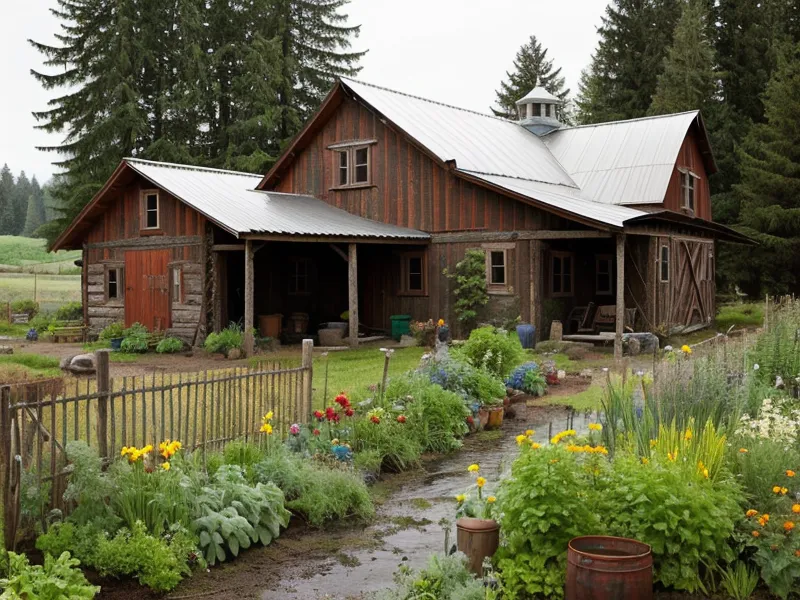
Buckets in both hands, mud already working past the tread of my boots, I'm running the same math I run most mornings before I even reach the barn door. Fourteen chickens, two goats, two dogs, one increasingly grumpy human — livestock watering on a small homestead sounds simple until you're the one hauling every gallon of it by hand across half-frozen ground.
Quick note before we get into it: this post contains a few affiliate links, and if you buy through them I earn a small commission at no extra cost to you. I only mention gear that earned a permanent spot in the barn setup — everything else gets returned, or shoved in the shed to be forgotten.
The Daily Math Behind Homestead Water and Livestock Care
Between the chickens (roughly 0.15 gallons each), the goats (about 2 gallons apiece), and the dogs (around 0.7 gallons each), our actual daily total lands close to 7.5 gallons. That number looks small right up until you translate it into bucket trips — call it 21 a week if you're hauling with a 2.5-gallon pail — and then multiply that by a stretch where the ground is either frozen solid or ankle-deep mud. Well recovery rate, meaning how fast the well refills between draws, matters more here than most new homesteaders expect, because a slow-recovering well and a thirsty menagerie do not mix well on the same afternoon.
Whatever sits between the well and the spigot — pressure tank included — decides whether that math turns into a minor chore or a full-blown fight, and ours has picked a fight more than once. Who wants to trudge out and eyeball a trough every few hours in January just to make sure nobody's gone thirsty?
Why I Started With Buckets, DIY Backups, and a Water Test I Filed Away
Hauling by hand was never going to survive an Oregon winter, so the first upgrade was a gravity-fed backup rigged from spare parts and whatever fittings I had lying around — a DIY farming fix if there ever was one. Elliot, the plumber from the next town over, took one look at it and predicted it wouldn't make it through the season. He has NEVER once been wrong about this property, and this time was no exception — the fittings I trusted didn't hold once the temperature swung, which is what sent me down the rabbit hole that became The Frozen Pipe Panic: My Lazy Oregon Winterizing Checklist.
Somewhere in that same stretch I finally called the county health lab and had our well water tested, mostly because a neighbor kept asking if I actually knew what was in it. The results came back, I skimmed them once, and then — this is the embarrassing part — I filed the paperwork in a drawer and never circled back to act on a single line of it. If the test had come back bad, the next move would've been shock chlorinating the well with bleach and waiting out the smell, but ours didn't, so that project stayed theoretical. Well water safety is one of those things you mean to stay on top of until the next chicken emergency eats the whole afternoon.
Evaluating Automated Systems
By the third rebuild of the hose rig, I gave in and tried the SmartWaterBox, a low-pressure valve system built to handle the swings of a private well without back-feeding into the house supply. Oregon takes backflow prevention seriously for good reason — nobody wants chicken-trough water finding its way anywhere near a kitchen tap. It felt like a manageable, one-time bet compared to another season of duct-taped hose repairs.
Unlike the gravity-fed distribution I'd rigged by hand, which only worked if every fitting held and every slope was right, this thing just needed power and a signal to keep running. It doesn't touch sediment filtration — clearing out grit and cloudiness — or UV disinfection for anything biological that might be living in the water; if your well runs cloudy after a hard rain or a test comes back with something concerning, those stay separate projects, not something an automated valve solves for you.
The Night The Power Went Out
A storm knocked the power out for the better part of a day not long after the SmartWaterBox went in, and that turned out to be the real test. I'd rigged a small gravity-fed assist off the same setup using ideas from my DIY greywater system, mostly zip ties and stubbornness dressed up as engineering. The goats never noticed the storm at all, drinking from a trough that kept topping itself off without me touching it, and the dogs, unimpressed as always, just wanted their dinner.
I checked the tank level once from bed, half out of habit, and watched the number hold steady straight through a full load of laundry I'd run that morning — tank-level monitoring, it turns out, is less about catching disasters and more about not lying awake wondering. Read more of that outage story in When the Power Grid Quits: My Dark Reset Survival Strategy. The rain barrels handled the overflow the way they always do — crack the lid in August and you get hit with a thick green smell that tells you it's time to route that water to the garden instead of the trough, a rainwater harvesting lesson nobody puts in the brochure.
Choosing Between Hauling and Automating
Bert, a retired irrigation engineer who lives a few properties over, wandered by not long after the storm and asked why I hadn't backed the whole trough system with a second, smaller tank instead of relying on one point of failure — a question I genuinely hadn't thought to ask myself, which seems to be his specialty. Manual hauling and a gravity-fed backup cost less money upfront and force you to actually understand your own system, pipe by pipe, which matters if you're the type who wants to fix things yourself at odd hours. An automated setup like the SmartWaterBox costs more initially and still needs power to run, but it buys back hours every week and holds up better when your hands are already full of chicken feed and dog leashes.
If you're just getting your feet wet — pun very much intended — start with the manual backup so you actually learn where every valve and joint lives on your property, then add automation once you know exactly what you're protecting. For us that meant eventually leaning on the SmartWaterBox full-time, not because the DIY version failed outright, but because hauling water for a menagerie this size stopped being character-building and just became a chore I was glad to hand off.