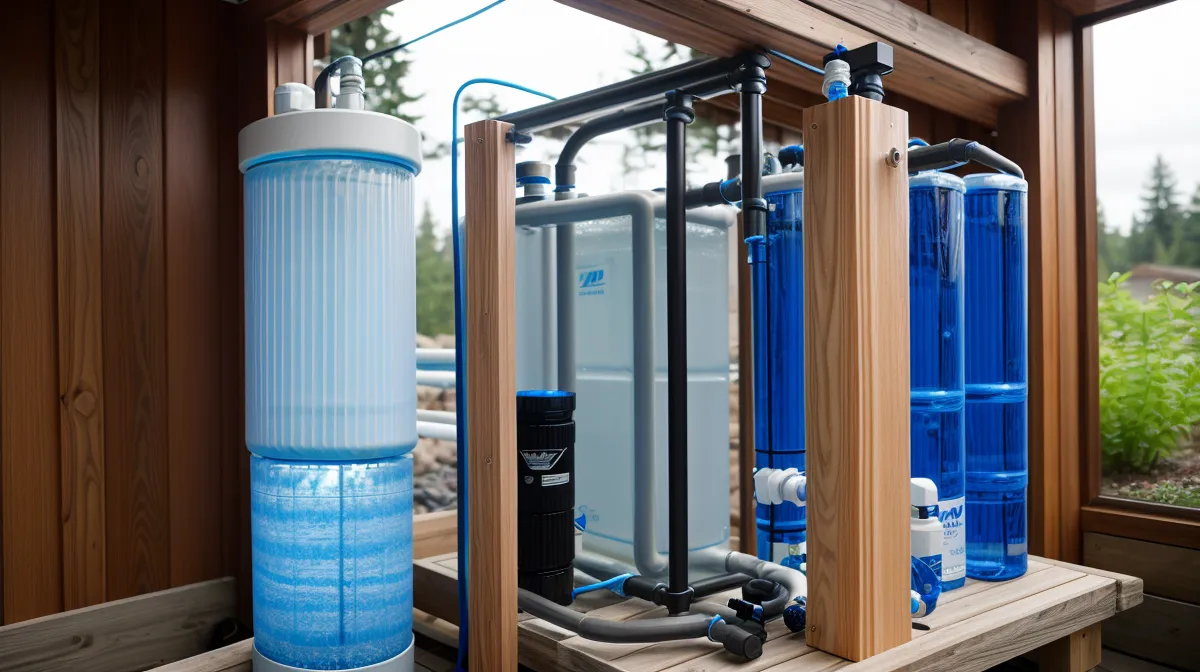
Two hundred fifty-four nanometers is a strange thing to have memorized, but it's the ultraviolet wavelength running through our SmartWaterBox unit, and it's the reason chlorine and I don't really speak anymore. This isn't a story about finding the perfect well water treatment on the first try. It's about switching from a system built on bleach to one built on UV purification, and everything that homestead plumbing decision did and didn't fix.
Quick heads-up before we go further: this post has affiliate links, and if you buy through one, I earn a small commission at no extra cost to you. I'm not a water quality scientist or a licensed well contractor — just a homesteader who has spent a lot of weekends knee-deep in well maintenance figuring out what actually works. Talk to your own well professional before making changes to your system.
Here's a confession that has nothing to do with jeans, for once: the first time we suspected trouble, I called the county health lab, paid for a water test, and got a report back that went straight into a kitchen drawer, unopened, until something reminded me it existed. By the time I finally read it, the word 'coliform' was circled in the kind of red ink that makes your stomach drop.
The Chlorine Problem That Started This Switch
Once I actually read the report, we did the thing every well guide recommends — shock the whole system with bleach. That part is its own disaster of a story, and it cost me a favorite pair of jeans I'll never wear again.

Try telling two thirsty dogs and a flock of chickens that the water is off-limits for the better part of a day while you wait out the contact time. It does not go over well, and it didn't win me any homesteading points either.
Finding My Way to UV Purification
That's when I found Ultraviolet germicidal irradiation and started reading everything I could about it: no measuring, no mixing, no smell, just a bulb doing its work quietly inside a chamber.
We'd already had enough water drama for one homestead, like the summer I wrote about managing our well after the summer we ran it dry, and I wasn't looking for another high-maintenance project. I wanted something closer to set it up and stop thinking about it.
The Limits of UV Purification
UV light only deals with whatever passes directly under the bulb at that exact moment. It won't touch lead, pesticides, or anything else chemical. If that's what's in your water, UV alone is NOT going to save you, full stop.
The bigger surprise, at least for me, was residual protection, or the lack of it. Chlorine keeps killing things all the way to your faucet. UV stops working the instant the water clears the bulb, which matters a lot more once you understand what's living in the rest of your plumbing.
What's Really Living In Your Homestead Plumbing?
That gap matters most if your pipes are old. Ours are pushing forty years, and aging plumbing tends to grow biofilm, a slimy bacterial layer that thrives in damp, dark places and doesn't care how clean the water was when it left the well. UV at the source never touches that stuff.
We ended up adding David's Shield to close that gap, since it works on the residual side of the problem instead of just the point-of-entry side. I wrote up the longer version of how that's held up in my honest review of David's Shield, if you want the full picture.

Don't Skip the Sediment Pre-Filter
UV has one more blind spot worth knowing about: sediment. A speck of grit floating past the bulb can shield bacteria from the light like a tiny umbrella, a problem the water nerds call shadowing.
The fix is a decent pre-filter installed ahead of the UV chamber, not after it. If you're shopping for one, the best sediment filter for well water post walks through what actually matters when you're picking one.
Choosing a Well Water Treatment: UV or Chlorine?
Here's how to decide between the two: a handful of questions cut through most of the noise.
Start with what you're actually treating for. If it's bacteria and not a chemical problem, UV clears that bar easily — organisms like Cryptosporidium and Giardia, which shrug off ordinary chlorine doses, don't stand much of a chance against UV light. Ask how much daily disruption your household can stomach, too: chlorine shocking means no water for cooking, laundry, or thirsty animals for a good chunk of a day, while UV doesn't ask you to give up anything. Then look at your plumbing: older pipes with biofilm need a residual solution working alongside UV, not instead of it. And be honest about maintenance: chlorine means measuring and re-dosing on a schedule, while UV mostly means one honest chore a year.
Comparing the two is a little like comparing garden vegetables you tend every day to a pantry you stock once and mostly forget about. One wants your attention on a schedule, the other wants a bigger decision up front and then leaves you alone.
My neighbor Bert Yamamoto, a retired irrigation engineer, has a line about water pressure being 'the mood of the system.' I think disinfection works about the same way: chlorine is moody and needs constant tending, while UV mostly just gets on with its job in the background.
I used to think a 'pressure tank' was something you strapped on for scuba diving, not a piece of equipment bolted to a wall. Water testing is a bit like that too. Crack open a rain barrel lid in August sometime, and the green smell alone will tell you more about what's growing in your water than most lab reports ever will.
Living With a UV System, Day to Day
The maintenance itself turned out to be almost anticlimactic. Once a year, the SmartWaterBox beeps to let me know the bulb's germicidal punch is fading even though it still glows, and swapping it takes about as much effort as changing a lightbulb: shut off the water, unscrew the housing, swap the bulb, turn the water back on. No mixing, no splashing, no eye-watering fumes.

Elliot Morozov, the plumber from the next town over who saved our whole system the winter a pipe burst, is the person I run every plumbing decision past before I commit to it. Even he shrugged and admitted UV was the boring, sensible choice, which from Elliot is basically a five-star review.
These days the chickens' waterer goes long stretches without me topping it off by hand, and this is the first winter that's held true from start to finish. Nobody in this house, feathered or otherwise, has had a water complaint since.
If you've had a recent flood or a major system failure, none of this replaces a one-time shock. I've chronicled that whole process in my post about shocking a well with bleach after a flooding event. But for the regular, day-to-day business of keeping water safe, UV is what I'd reach for again.
UV isn't a magic fix, and it never fully replaces good judgment about what's actually in your water. But it's been the boring, reliable kind of good for us: no chemistry degree required, no more ruined jeans, and one less thing to worry about every time someone in this house turns on the tap.