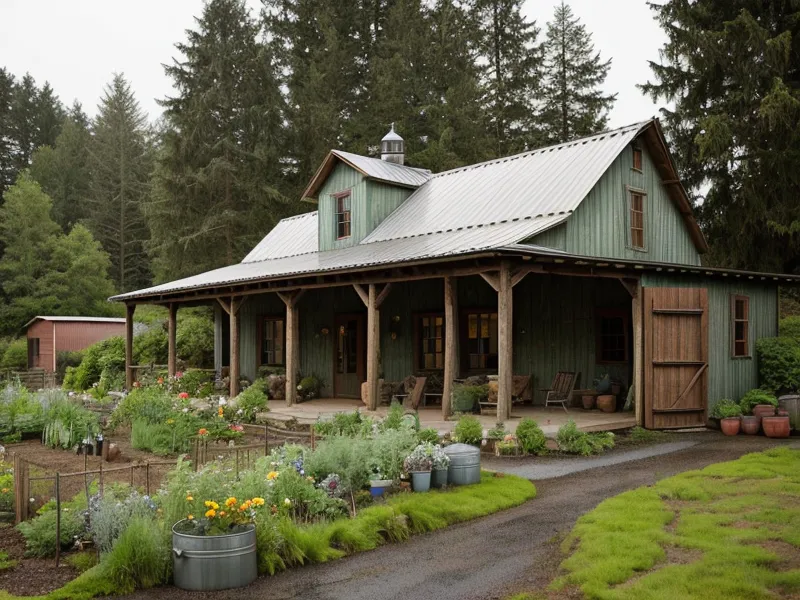
How many pounds of water do you think you can drag across muddy ground before your back simply refuses to cooperate? That question is what rain collection and water storage on this Oregon garden property come down to for me these days, three years into running a system that started as scavenged blue barrels and slowly turned into something built around actual homestead ergonomics instead of whatever was free that week.
Update (September 2026): Aqua Tower is no longer available for purchase; this article is kept for reference. Our current alternative pick in this category is Water Freedom System.
A quick heads-up before any of this goes further: some of the links below are affiliate links, and if you buy through them I earn a small commission at no extra cost to you. I only mention things that have actually spent time on this five-acre property, usually right after something cheaper let me down first.
The Ergonomics Problem Nobody Puts on the Box
Ground-level water storage looks deceptively simple in a photograph. Every blue barrel picture on gardening forums makes it look like you just set it down and walk away, and nobody mentions what happens once you actually need to move a full one.
A standard 55-gallon blue barrel, filled all the way, weighs 458.7 pounds, a number I only learned after trying to "just nudge" one out of the mud and feeling something unpleasant happen in my lower back. The three forty-gallon barrels we still keep stacked under the porch eave are lighter, but "lighter" is relative when you're the one lifting, and I stopped pretending years ago that I could wrestle any of them once they're full.
None of this is really about the main well pump, but the same principle showed up there too. I've run the washer, the dishwasher, and an outside hose bib at the same time and watched our main pressure gauge simply NOT move, which is exactly the kind of steady reading that got me pointing homestead friends toward SmartWaterBox instead of a lawn chair and a lot of hoping. It tracks that number automatically so you're not the one babysitting a dial.
Why We Finally Went Vertical
My lower back is what actually pushed the decision, not a spreadsheet. After enough mornings spent wincing while filling a watering can from a barrel sitting at ankle height, I gave in and ordered the Aqua Tower, which ran $46.54 — real money when "free" barrels are still sitting in half the yards around here, but cheap compared to what a chiropractor charges.
Footprint mattered more than I expected once I actually measured it. My old barrel setup, propped on a wooden stand held together with more zip ties than I want to admit, took up about 6 square feet of garden space. The Aqua Tower's base needs just 4 square feet, which sounds like a small difference until the chickens are already contesting every inch of open dirt around the tomatoes.
Does Height Actually Change the Physics?
Height alone does more work than most people expect. I'm no engineer, but static pressure turns out to be the reason a tank up on legs can push water through a hose without any pump at all — ours gains roughly 2.16 PSI just from sitting elevated, a small number that matters a lot once the tomatoes at the far end of the row need a drink. I won't turn this into a full physics lecture since gravity-fed systems deserve their own deep dive elsewhere on this site, but that pressure bump is the entire reason the tower earns its keep.
What Freezing Weather Taught Me the Hard Way
Cold weather exposes every shortcut you've taken. One November, I ran a cheap garden hose as a temporary line between the tower and the coop instead of installing proper pipe, telling myself I'd get to it properly once I had more time.
That hose cracked wide open in the first hard frost, and I found the split while carrying a bucket out to the dogs on a morning too cold for anyone's mood. Lesson noted: anything left exposed through an Oregon winter needs actual insulated line, not whatever happened to be in the garage. It's also why watering the menagerie during a cold snap now means checking the animals' water before I check my own coffee — a frozen line for the chickens and dogs is a same-day emergency in a way a frozen line for the garden just isn't.
Keeping the Water Clean Without Turning Into a Contortionist
Sitting low to the ground causes its own kind of trouble. Barrels at ground level attract every slug, curious hen, and stray bit of debris within reach, and scrubbing algae out of a bung-hole with a bottle brush while the dogs bark at something in the tree line is not how I want to spend an afternoon.
Hard well water leaves its own evidence, too — I've watched a crusty pale ring build up inside our kettle after just a few days of use, so I already know what mineral buildup looks like before it becomes a problem I can't see inside a closed barrel. The HDPE plastic barrels are sturdy, but their narrow openings make it hard to reach in and check on any of that, whereas the tower's design at least gives me an actual view of what's settling at the bottom.
If you want the deeper story on why I take sediment seriously, the filter change fiasco covers that in full. The short version here is that anything you can't easily inspect will eventually surprise you, and a system that lets you actually see the water matters more than I expected when I bought it just for the height.
Choosing Between a Tower and Barrels for Your Setup
A reader named Corinne Specht emails me every few months about her own well setup two time zones east, and she asked recently which system she should build first if her budget only stretched to one. My answer depends entirely on her actual constraints, not on which product I personally like better.
Space-constrained gardens next to the house favor the tower every time — the smaller footprint and the gravity feed save real effort on a property where every square foot already has a job. Larger acreage with room to spread barrels around, especially if some of that rainwater is feeding a collection setup further from the house, can still make barrels the more practical choice, since moving water short distances by hand matters less when you're not doing it daily.
Filtration needs change the math too. For heavier filtration closer to the house, I still keep a David's Shield unit running, separate from anything doing garden duty. And if the actual worry is a longer power outage rather than a slow Tuesday afternoon, that's a different problem entirely — my Dark Reset survival strategy leans on a Dark Reset unit for exactly that scenario, and mixing up which problem you're actually solving is the fastest way to buy the wrong thing.
Where I Landed, Chickens and All
My old blue barrels didn't end up in a landfill, for what it's worth. They got repurposed as nesting boxes, and they turn out to be much better at holding one opinionated hen than they ever were at holding water in the mud.
Priscilla Hartung, a friend with her own twenty-acre spread near Roseburg, texted me a photo of her identically cursed plumbing last month, which is usually how I know I'm not imagining how much harder this all is than it looks online. Every homestead water setup fights you somewhere.
For day-to-day garden use on a property where space and a bad back are both real constraints, the Aqua Tower is what earns its spot by my porch now. If your setup looks anything like mine did — barrels doing double duty as furniture for the mud — it might be worth the same switch before next winter, not after.