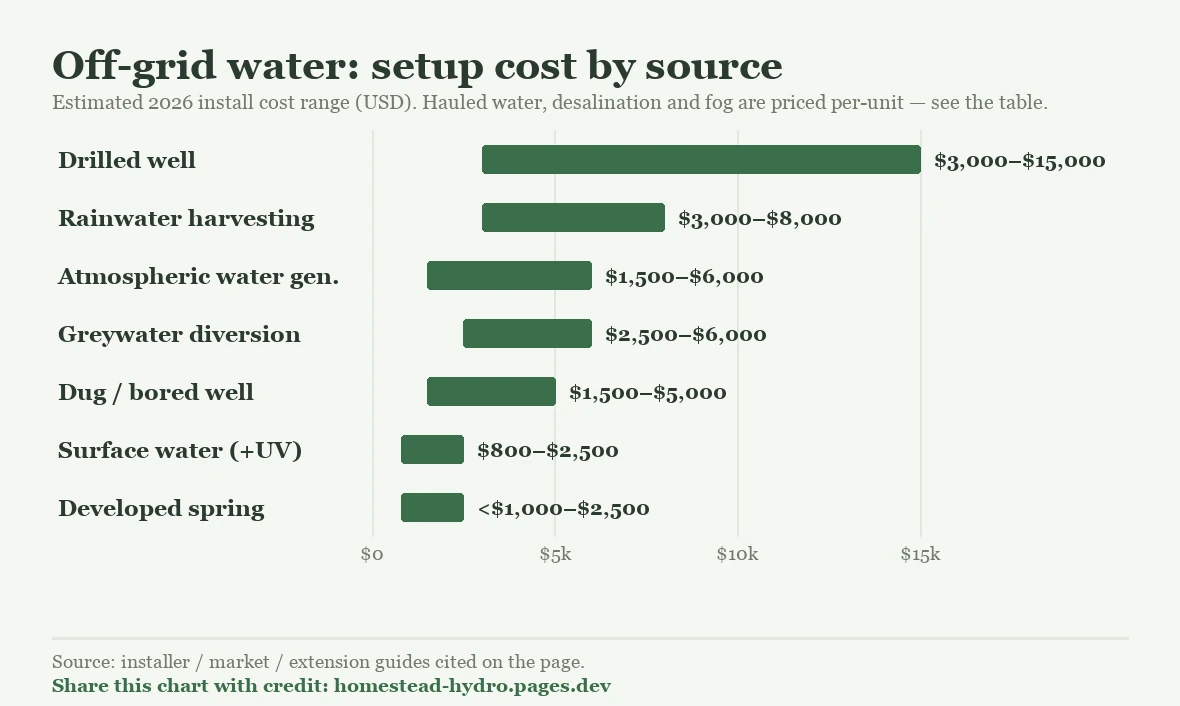
The honest math: the cheapest reliable off-grid water isn't a gadget — a developed spring can cost a few hundred dollars and needs no pump or power, while an atmospheric water generator burns roughly 1 kWh per gallon and quietly becomes a second electric bill.
Off-Grid Water Source Comparison Table
Here's how the ten water sources we actually looked at (or tried, or gave up on) stack up on cost, output, and upkeep — pulled from real 2026 installer and market pricing, not guesswork.
| Water Source Type | Estimated Initial Cost (2026 USD) | Typical Yield / Capacity | Primary Maintenance | Reliability Factor |
|---|---|---|---|---|
| Drilled Well | $3,000 – $15,000 [1] | 3 – 15+ Gallons Per Minute (GPM) [2] | Pump and electrical inspection | High (Aquifer dependent) |
| Dug / Bored Well | $1,500 – $5,000 [3] | Low to Moderate | Annual disinfection; sediment removal | Moderate (Seasonal fluctuations) |
| Rainwater Harvesting | $3,000 – $8,000 [4] | 0.623 gal / sq. ft. per inch of rain [4] | Filter cleaning; tank sediment flush | Variable (Climate dependent) |
| Developed Spring | Under $1,000 (DIY) – $2,500 (Professional) [5] | 2 – 5+ GPM (year-round drinking supply needs 2+) [5] | Sediment basin clearing | High (Perennial springs) |
| Atmospheric Water Generator | $1,500 – $6,000 (Countertop unit) [6] | 2 – 10 Gallons Per Day [6] | Air and water filter replacement | Moderate (Humidity dependent) |
| Hauled Water (Cistern) | $200 per 1,000 gal (Delivery) [7] | Limited by tank size | Cistern disinfection | High (Service dependent) |
| Greywater Diversion | $2,500 – $6,000 [8] | 50 – 150 Gallons per day [8] | Lint filter cleaning | Moderate (Usage dependent) |
| Surface Water (Creek/Pond) | $800 – $2,500 (Sediment + UV) [9] | Variable (Flow dependent) | UV lamp and filter maintenance | Moderate (Drought risk) |
| Fog Harvesting | Low (Mesh and frame) | 5 – 20+ Liters / m² per fog day [10] | Mesh cleaning and tensioning | Low (Geographic specific) |
| Small-Scale Desalination | $1,800 – $2,500 per m³/day cap. [11] | Varies by unit size | Membrane replacement (5–7 years) [11] | High (Coastal areas) |
Kate's Field Notes
The table's the clinical version. Here's the version with opinions in it.
- Surprise winner: a developed spring — cheap, no pump, no power bill (if you're lucky enough to have one).
- Most reliable, worth the money: a drilled well — the "just pay someone who knows what they're doing" option.
- Confirmed dud in a dry-summer climate: an atmospheric water generator — the energy math made bottled water look reasonable.
- Emergency-only: hauled water — expensive per gallon, but the only thing that shows up THIS WEEK.
Drilled wells are the "just pay someone who knows what they're doing" option, and after our dry-pump summer I get why people default to them — ours has never once made me nervous the way our rain barrels do in a dry August. It's not cheap, but neither is hauling water for a season, which we also did, for two miserable months, before the well guy could get out here.
Rainwater harvesting sounds simple until you actually do the math on your own roof, and honestly the formula looks scarier than it is — it's really just roof size times rainfall times a fixed conversion number, kind of like figuring out how many mason jars of tomatoes you'll get out of a given row of plants. You measure what's coming in, you plan storage for it, and you accept that some of it splashes off the gutter before you ever catch it.
Developed springs were the surprise winner for us — if you're lucky enough to have one. Our neighbor two properties over did the whole thing herself with a shovel, some gravel, and a plastic spring box for something like a weekend's labor and a few hundred dollars in materials, and now she's never paid a power bill for water in her life because there's no pump. It's basically the off-grid equivalent of finding out the previous owner already planted an apple tree — you didn't do the hard part, you just have to not mess it up.
The atmospheric water generator is our confirmed dud. We looked hard at a countertop unit after seeing an ad — they start around $1,500 — and I was genuinely excited for about ten minutes until I ran the electricity math for our climate. Western Oregon is damp enough in winter but bone-dry by August, right when you'd actually want the thing working, and the energy cost per gallon made bottled water look reasonable. It's in the "nope" pile next to the solar attic fan that died eight months in.
Greywater diversion is on the someday list — reusing shower and laundry water for the garden instead of the septic field feels like the kind of budgeting trick you'd use on groceries, just for water instead of money. We haven't done it yet because our laundry room is nowhere near the garden and I am, as previously established, not particularly handy.
Hauled water got us through that dry-pump summer, and I will say this for it: the delivery truck driver was more reassuring than any of the panicked forum threads I read at 11pm that week. It's expensive per gallon compared to almost anything else on this list, but when you need water THIS WEEK, it's the only thing on the table that actually shows up on time.
Technical Definitions and Yield Formulas
- Rainwater Yield Formula
- Potential annual harvest is calculated as: Roof Area (sq. ft.) × Annual Rainfall (inches) × 0.623 = Total Gallons. In the real world you only keep 75–85% of that number after evaporation, gutter overflow, and "first-flush diversion" take their cut [4] — first-flush just means the dirty first few gallons off a dusty roof that you deliberately dump instead of storing, the same way you'd toss the first thin pancake in the pan.
- Atmospheric Water Generation (AWG) Efficiency
- A residential AWG running at rated output uses roughly 0.93 to 1.09 kWh per gallon produced — 245 to 288 Wh per liter, if you think in metric [6]. That's why the countertop unit we almost bought would have quietly become a second electric bill.
- Spring Development
- Developing a spring means excavating upslope until you hit real flow, building a small rock-and-gravel "interception reservoir," and running a pipe from that reservoir into a sealed spring box that keeps leaves, animals, and surface runoff out of your water [12]. Think of it like building a little raised bed around a leak in the ground — contain it, filter it, then pipe it where you actually want it.
Regulatory and Reliability Factors
Every one of these systems runs into the same wall eventually: permits. Oregon made us get a permit just to drill our well, with a setback distance from the septic field that our driller had memorized better than I know my own phone number. Rainwater harvesting is actively encouraged with rebates in some states and legally restricted in others because of downstream water rights — check before you start bolting barrels together. Pulling water straight from a creek or pond usually means dealing with "riparian rights" or a water board allocation, which is a lot of paperwork for something that sounds as simple as sticking a hose in a stream.
Rule of thumb we've landed on after three years:
- Easiest to start: the systems that usually don't need a permit — rain barrels, hauled water (though rainwater harvesting is legally restricted in some states, so check first).
- Worth the extra weeks of paperwork if you're staying long-term: wells, big cisterns, anything touching a water right.
Your county extension office will know the local rules better than any article, ours included.
The information here is based on our own homestead experience and on the installer, extension, and market sources linked below — it's not professional advice. Off-grid water systems carry real health risks: contamination, waterborne illness, and structural failure if something's built wrong. Get your water tested before you drink it, follow your local permitting rules, and bring in a licensed well or septic professional for anything involving drilling, casing, or a septic setback. The interaction we'd flag hardest: untreated greywater or surface water used directly on food crops — that's a real route for E. coli exposure, not a theoretical one, so route it away from anything you're going to eat raw unless it's been properly filtered and disinfected first.
Last verified: 2026-07-12
Sources
- [1] Epp Well Solutions: Water Well Drilling Costs in 2026
- [2] ConstructlyTools: Well Drilling Cost Calculator
- [3] The Well Guide: Well Drilling Cost Calculator (Dug vs. Drilled Well)
- [4] Rainplan: Rainwater Harvesting System Cost — Complete Price Guide [2026]
- [5] The Survival Mom: How to Find and Tap into a Natural Spring on Your Property
- [6] Aquaria: Atmospheric Water Generator Cost — 2026 TCO Breakdown
- [7] Water-On-Demand: 2026 Water Hauling Pricing
- [8] Rainplan: Greywater System Basics [2026] — How It Works, Costs & Permits
- [9] The Well Guide: Whole House Water Filter Cost — What Well Owners Actually Pay in 2026
- [10] Wasserstiftung: CloudFisher Fog Harvesting Project
- [11] Besta Membrane: Seawater Desalination Costs & ROI 2025
- [12] Penn State Extension: Spring Development and Protection