
Washer running, dishwasher running, and the hose bib out back cranked wide open to rinse mud off a dog who finds every puddle on the property — and the pressure gauge in my mudroom hasn't moved. Not even a flicker. That's the moment I actually started trusting our whole-house sediment filter more than any brochure ever managed to.
Quick note before we get into it: a few links below are affiliate links, and if you buy through one I earn a small commission at no extra cost to you. This is the honest, DIY-homesteading version of rural living with well water — not the polished one, and definitely not the Pinterest one.
Is Whole-House Water Filtration Really Different From a Pitcher on the Counter?
Short answer: yes, and I learned it the expensive way. When we first moved onto our five acres in the Douglas County foothills, I bought a countertop pitcher filter from the local store and told myself that would cover our well water needs. It didn't. A pitcher is built to handle chlorine taste in city water — it does nothing for the fine sediment a well line kicks up after heavy rain. Does a countertop pitcher stand a chance against that? Not even close.
We spent our first months out here a little starry-eyed about groundwater — "natural," we kept saying, like that automatically meant clean. Natural also means whatever's down in that ground comes up with it. Ruthanne, my next-door neighbor, put it more bluntly than I ever could: pretty water and clean water are not the same thing. She doesn't sugarcoat things, and she's rarely wrong about this stuff.
If your bathwater leaves grit behind, or your coffee maker is clogging every few months no matter how often you descale it, that's your sign a pitcher filter isn't going to touch the problem. That's exactly the point where I looked at David's Shield instead of another gadget for the kitchen counter — something rated to handle the whole house, not just one tap.
The Real Story Behind Rural Well Water
Our kettle told the story before any test kit did. Within days of moving in, a thin gritty rim had built up along the waterline no matter how often I scrubbed it — that's hard well water doing exactly what hard well water does. I'm not a hydrologist and I won't pretend to fully understand the chemistry of what's dissolved down there. What I can tell you, from the receiving end of it, is that a whole-house filter catches physical sediment before it reaches your pipes and appliances, which is a different job than pulling dissolved iron or manganese out entirely.
Whether a well is shallow and dug or deep and drilled changes a lot about what shows up in the water — that's a whole separate rabbit hole, and not one I'm going to try to cover here. What matters for this conversation is simpler: if you're seeing grit, staining, or a kettle that looks decades older than it is, a sediment filter is solving a real, specific problem.

Installing David's Shield Without Losing a Finger
Installing this myself was equal parts satisfying and humbling. Armed with a wrench, more confidence than skill, and a tutorial video that made the whole process look suspiciously easy, I spent a Saturday morning on the pump house floor threading fittings into our existing line. Ruthanne wandered over partway through, took one look, and bluntly told me that I had the bypass valve backwards, the way she tells you everything. She was right. She's always right, which is somehow both useful and a little annoying.
The real mistake showed up later, when I turned the main valve back on without double-checking the O-ring seat. What followed was less a leak and more of a personal power wash straight to the face. Flashlight in a puddle, water everywhere, chickens losing their minds outside the door like I'd personally offended them. Once it was seated right, the gauge held steady at 50 PSI — no drips, no mist, NONE of the chaos from ten minutes earlier.
If you want a more all-in-one monitoring setup instead of, or alongside, a straight sediment filter, SmartWaterBox is worth a look too — different tool, different job. And if your pump starts doing something strange mid-install, cycling on and off for no clear reason, I've already covered why a well pump might click on and off constantly, which usually traces back to the pressure tank or switch rather than the filter itself.
The Winter Question Rural Well Owners Forget to Ask
June — who has never once waited for me to ask before forwarding her latest water test results — asked me this exact thing after hearing about our rough first summer: does a filter like this actually survive a hard freeze? Fair question. The honest answer is not on its own. Most of these units sit in an unheated pump house or shed, and without real insulation around the housing and lines, you're building a very expensive ice sculpture.
We found that out mid cold-snap, wrapping heat tape and fiberglass batts around fittings that should have been insulated from day one. The path out to our well head turns to ankle-deep mud most Novembers, which made hauling supplies out there at an unreasonable hour even worse than it sounds. It's not really about the filter at that point — it's about everything around it. Anyone heading into a first winter on rural property should read how to insulate a well pump house before the first freeze before the ground hardens, not after a housing cracks.
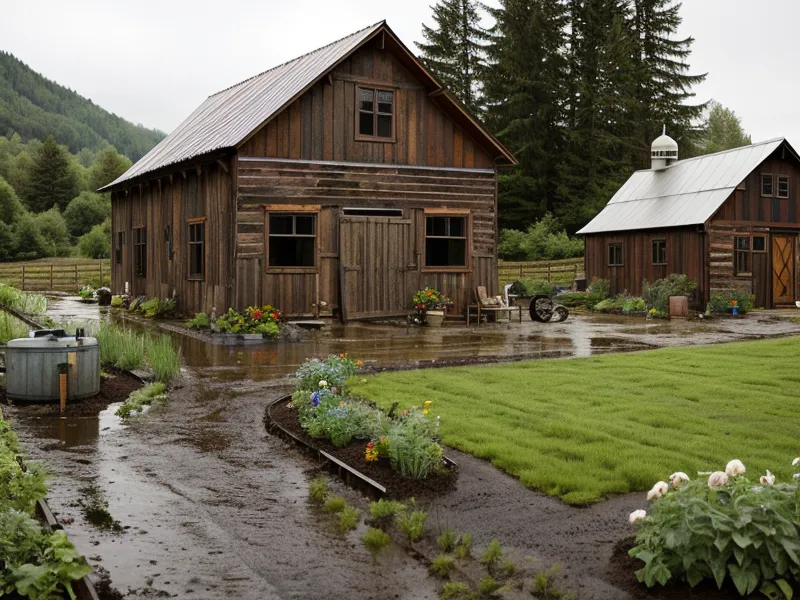
When the Whole Valley Floods
Storms are really the test that matters. A big Pacific Northwest system rolls through, the driveway turns into a creek, and normally our water gets moody for a few days afterward — cloudy, a little metallic, not something you want anywhere near your coffee. I've researched the best way to treat cloudy well water after a heavy storm more times than I'd like to admit. With the filter in place, that post-storm cloudiness just stops before it reaches the kitchen tap.
Our rain catchment setup still matters here too — a few blue barrels tucked along the porch roofline, older than most of our other gear and still doing its job as backup when the well needs a break. Anyone figuring out where to even put their own barrels might find finding the best place to put a rain barrel useful. A whole-house filter and a rain system solve different problems, but on a property like ours, you end up needing both eventually.
So, Is It Actually Worth Installing?
If you're on well water and tired of grit, staining, or a kettle that looks like it aged twenty years in two, then yes — David's Shield earned its place in our pump house. It won't fix bad pressure, a failing pump, or contamination that needs an actual lab test. Talk to a licensed well technician for that — I'm a homesteader with a wrench, not a professional. For sediment specifically, for the grit that used to leave a haze in the dog's water, it's done exactly the job it was supposed to do.
Our mudroom looks like a command center these days — gauges taped up at eye level, a hand-drawn map of every valve tacked over the sink so I stop guessing which one does what. Watch your O-rings, insulate before the first freeze, and keep the chickens out of the pump house while you work; they do not help. If you want the exact setup we run, Check out David's Shield. Your pipes will thank you, and honestly, so will your kettle.