Almost every "just put a barrel under your downspout" guide skips one critical detail. Here in rural Oregon, where rain-harvesting isn't a hobby so much as a survival skill for anyone trying to keep a homestead-water system running without draining the well dry, that missing detail is exactly why so many DIY rain barrels end up useless, tipped over, or quietly rotting the siding behind them. A reader named Corinne Specht emailed me after reading my post about running the well pump dry, and half her questions weren't even about the well but about where to actually put the barrel she'd already bought, and no, I was happy to explain the parts that felt obvious.
Most people assume the answer is obvious: pick the downspout closest to the back door, or wherever there's a flat, sunny patch near the garden. Neither passes the real test. A good spot has to hold serious weight without shifting, sit a little higher than whatever it's feeding, and send its overflow somewhere that won't come back to bite your foundation. Curb appeal has nothing to do with it. This was the single biggest mistake I made in my first year on this Oregon property.
The Rain-Harvesting Myth That Floods Your Mudroom
Picking the nearest downspout feels like common sense. It isn't far to walk, it's easy to check after a storm, and it looks tidy from the porch. But "nearest" ignores the two things that actually matter: where the water needs to end up, and where it goes once the barrel is already full. Our garden sits uphill from the downspout I originally chose, so every gallon collected there was basically stranded — I'd have needed a powered pump just to move it fifteen feet, buckets in hand, which is its own kind of ridiculous on a five-acre place.
Under a big, active section of roof, a barrel fills fast — faster than most first-timers expect, especially during a real Oregon downpour. That's fine, until it overflows straight back toward your own foundation, which is exactly what a downspout right next to the house sets you up for. The broader idea behind rainwater harvesting sounds simple in theory. Placement is where it actually gets complicated.
Level Ground, Not Pretty Ground
Flat is not the same thing as solid, and I learned that the hard way one January morning when I walked out to find my main barrel leaning at an angle that made the chickens stop and stare — which, if you've never seen chickens genuinely alarmed by something, is its own kind of warning sign. I'd set the barrel on a few bricks I'd found in the barn and called it level enough. It was NOT. A full barrel is heavier than it looks, heavier than you'd want to find out the hard way, and loose dirt or stacked bricks will eventually give way under that kind of weight — usually right when the ground is softest, which around here means the middle of the rainy season.
Compacted gravel and solid pavers fixed it, and the barrels tucked under the eave off the porch that same winter are still sitting there today, untouched, doing their job — I walked through the whole process in how I built a rainwater collection system for my vegetable garden. That's really the whole test for a base: could it hold that weight through a wet winter without shifting? This is basically the same logic behind water-storage capacity planning in general — the container matters less than what's underneath it.
Why Does Elevation Matter More Than You Think?
Because gravity is doing the pump's job, whether you plan for it or not. If your barrel sits flat on the ground and your garden beds are also at ground level, you're not moving water anywhere — you're just storing it. I spent an embarrassing stretch of one spring turning a spigot and watching water dribble out like it was doing me a favor, because the barrel and the bed were sitting at exactly the same height.
You don't need scaffolding for this. A few sturdy cinder blocks, set on that same solid, level base, does the job. Skip this step and you'll spend the whole growing season blaming your hose when the real problem was sitting six inches too low the entire time.
Raising the barrel is the whole idea, and it's basically the same logic behind setting up gravity-fed drip irrigation from my storage tank — I'll point you there for the fuller version instead of repeating it all here. No electricity required, either, which matters a lot when your well pump and your power are already tied together.
Plan the Overflow Before the First Storm
Central downspouts — the ones closest to the main part of the house — feel like the obvious choice because that's where the most water collects. That's also exactly why they're the wrong choice. Once that barrel fills, and it will, the overflow needs somewhere to go that isn't straight down against your foundation. A softened crawlspace or a cracked slab is a far bigger project than moving a barrel twenty feet.
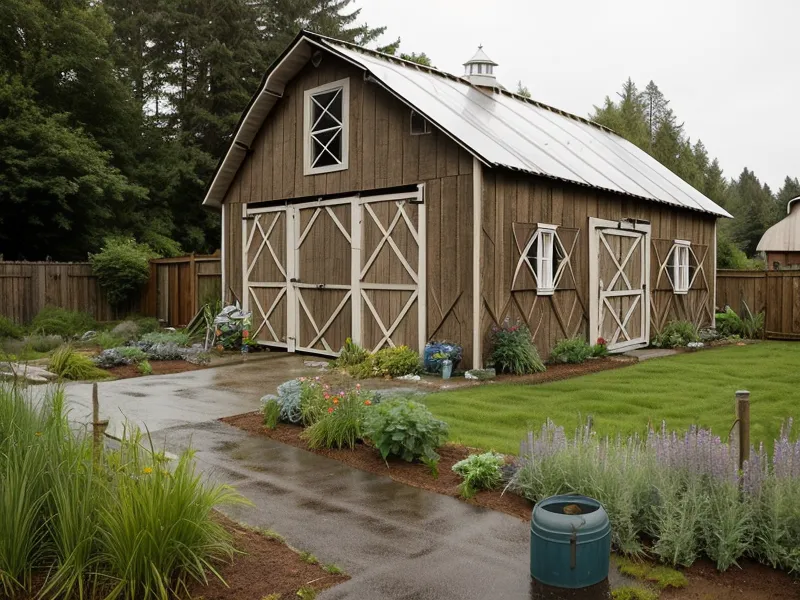
Detached structures solve this almost by accident. I moved my main barrel to the corner of the shop, where the overflow just runs off into the field instead of pooling against anything I care about. For a while after that move, I ran the connecting line with a cheap garden hose I had lying around, meaning to replace it before winter. I didn't, and it split wide open in the first hard frost, which turned into its own lesson about freeze protection I'll spare you here except to say: don't do what I did. Perimeter downspouts, sheds, coops, detached garages — anywhere the runoff has a clear, harmless place to land — will save you a repair bill and a headache.
There's a quieter reason to think about placement, too. I still remember the first morning the sulfur smell was finally gone from our kitchen tap, rinsing garden lettuce and actually trusting the water coming out of it — a small, specific kind of relief that has nothing to do with rain barrels directly, except that it's the same instinct: paying attention to where your water comes from, and where it goes, changes how you live out here.
Where I'd Actually Put a Barrel, Given the Chance Again
Skip the Pinterest-pretty corner. Start with the base — gravel and pavers, not dirt, not stacked brick, something that will hold its shape through a soaked winter without shifting an inch. Put it slightly higher than whatever you're trying to water, even if that just means a couple of cinder blocks, because gravity really is doing you a favor for free. Choose a downspout at the end of the roofline or on a detached structure over the one closest to the house, and trace where the overflow actually travels before you commit — not where you assume it will go.
Accessibility matters more than people admit, too. Tuck a barrel into a cramped, overgrown corner and you'll dread the day you need to clean it — and you will need to, which is a whole separate project I cover in cleaning a plastic water storage tank without harsh chemicals. None of this requires an engineering degree. It requires watching what your land actually does in a storm instead of guessing from the porch, and being willing to move a barrel twenty feet if the first spot turns out to be wrong.
I'm not a professional, and my own barrels have moved more times than I'd like to admit before landing somewhere sensible. If you're worried about drainage or anything structural near your foundation, that's a conversation for someone licensed, not a homesteading blog. For everything short of that, it really does come down to watching where the water wants to go — and setting the barrel up somewhere that works with that instead of against it.