
My hand was already slick against the ball valve, one quarter-turn in, before the hose even caught its first drop. That lag between turning a handle and water actually showing up is exactly why gravity-fed watering gets dismissed by people who've never tried it. Rainwater harvesting on a rural Oregon property sounds simple until you're the one standing under an IBC tote waiting on physics to catch up with your patience. DIY homesteading has a way of teaching you that a system can work perfectly and still not work on your schedule.
Here's the misconception that gets repeated at every farm supply counter and homesteading forum I've ever lurked on: a rain barrel setup only becomes useful once you add a pump. It's backwards. The pump is usually the first thing to fail, and what actually moves water without a single part to break down is height, plain, boring, unglamorous HEIGHT.
The Rainwater Harvesting Myth Nobody Corrects
A friend of mine, the kind who's usually out logging miles on the Ridgeline Trail above Eugene training for whatever race is next on her calendar, asked me flat out why I hadn't just added a pump like everyone else does. It's a fair question. Most people picture rainwater harvesting as barrels plus a pump plus maybe a timer, something with a plug involved, because a plug feels like progress. None of that is actually required, and treating it like the default is how people end up with an expensive dead pump sitting in a shed by August.
The barrels themselves aren't the complicated part. An IBC tote — one of those big white cubes in a metal cage parked behind half the outbuildings around here — holds around 275 gallons, and water is heavier than most people expect going in. Once it's full, that tote isn't something you casually relocate. You decide where it lives before it fills, not after.
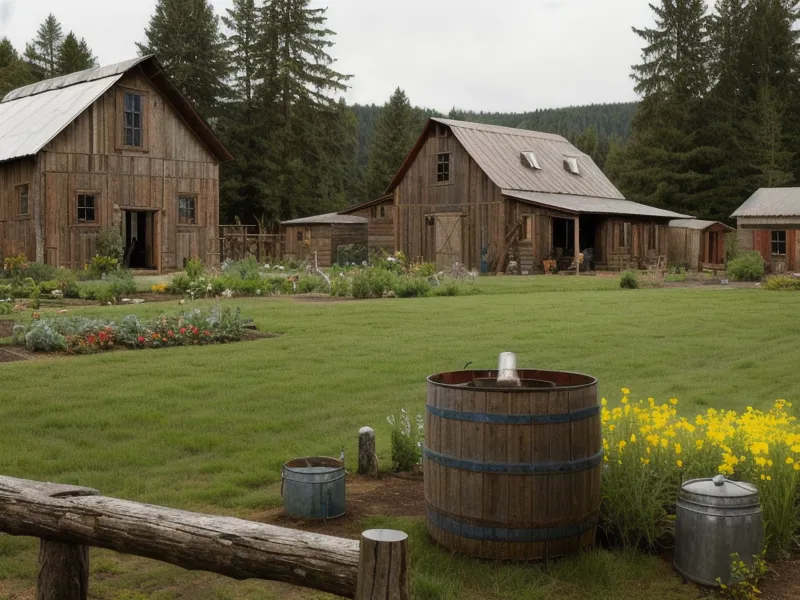
That weight is exactly why gravity works in your favor here instead of against it. A full tote sitting at ground level is just dead weight with a spigot. Raise it three or four feet, and the same tote becomes a pressure source, no pump, no cord, nothing to burn out.
Why Gravity-Fed Watering Doesn't Need a Pump
The number that finally made this click for me is almost embarrassingly small: about 0.433 pounds per square inch for every foot you lift the tank. Stack a couple of cinder blocks under a stand, get the tote three or four feet off the ground, and you've got enough pressure to run a soaker hose or a drip line through the whole vegetable garden without plugging anything in. It sounds too simple to count as real advice. It's real advice anyway.
I only fully trusted that math after an extension agent at the Yamhill County OSU Extension Office ran me through it on a folding table, timing how fast a bucket filled from different heights with a garden hose. Watching it happen in real time did more for me than any chart could have. That's also where I got straight talk about the difference between testing water you're about to drink and just eyeballing water you're about to pour on lettuce. I'd been treating those as the same task, and they aren't.
None of this has anything to do with the pressure tank that keeps the taps running inside the house, which relies on compressed air in a sealed chamber rather than a tote up on blocks. Different problem, different fix, and mixing the two up is how people talk themselves out of a system that would actually work fine for the garden.

Building the manifold — the fitting that splits one line into several so it can reach different garden beds — took a full weekend and more measuring than I expected, mostly because the chickens treated every tool I set down as something worth investigating personally. Get the layout right, though, and the whole thing runs quiet, no motor, no hum, just a valve opening and gravity doing the rest.
Trusting the System Instead of Checking It
The one thing I tried that flatly did not work: setting phone alarms to check the tank level manually three times a day. It lasted about a week. Chickens don't care that your alarm just went off, the mail truck doesn't wait, and glancing at a tote from across the yard tells you almost nothing useful about how many gallons are actually left inside it.
There's a whole category of gear built to solve exactly that annoyance — a tank monitor that texts your phone the moment a level drops, sensors wired into the tote, the works — and for some setups that's a legitimate answer. It's just not what a gravity system needs to run. None of this touches well recovery rates, or the far more nerve-wracking project of shocking a well with bleach after a flood, or UV disinfection for water headed to an indoor tap. Those are house-water problems with their own rules, and I still think about the sound of silence when we ran our well dry every time I'm tempted to get casual about any of it.
Bigger Tank, Worse Water?
The other myth worth killing is the idea that bigger is automatically better. You should buy the biggest tank your budget and your yard allow. Water sitting still for months doesn't stay clean just because the container holding it is impressively large. It gets stagnant, grows things you don't want anywhere near your tomatoes, and takes more effort to keep usable than a smaller tank you actually cycle through.
I run several 275-gallon totes instead of one giant cistern, and I empty and refill them through the wet months instead of letting any single one sit untouched. Why keep three hundred gallons around just to watch it turn into a science project? It's the same logic as rotating food in a pantry instead of letting the oldest can sit in the back for a decade. Use what's fresh, replace it, repeat.
Grit and debris are a separate issue from stagnation, and no amount of turnover fixes a clogged line. That's a sediment filter's job, not the tank schedule. Testing for drinking quality is its own project entirely too, and inside the house I went looking for finding a whole house well water filtration system for my family built around our own water instead of guessing, but that system has nothing to do with what falls off the roof and into a tote for the garden.

These days the dogs walk straight up to their water bowl and drink without that cautious sniff first, which sounds like a small thing, but it's the only monitoring system I actually trust. If the animals aren't hesitating, the water's fine, and whatever's plumbed underneath it is doing its job without me hovering over it.
Three years into this, here's the rule I'd hand anyone starting out: don't buy a pump before you've tried height, and don't buy the biggest tank before you've thought about how fast you'll actually use what's inside it. Gravity and turnover solve more problems than gear does, and neither one has a failure mode that involves a breaker box.
Out here, the chickens still treat every new piece of pipe as a perch, the garden bed lines are still a little uneven, and the whole rig is held together with more zip ties than any inspector would love. Turn that valve now, though, and the water just moves, quiet, no motor, no cord, exactly where I pointed it.