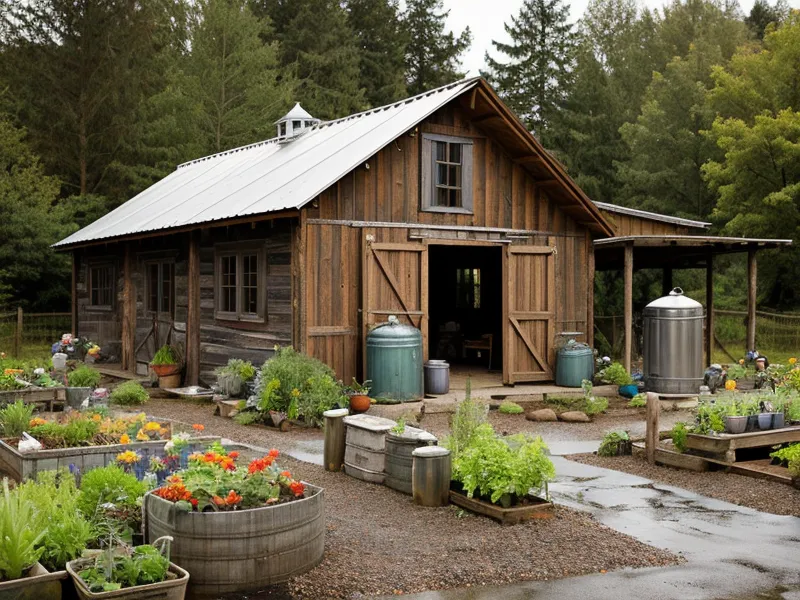
The hacksaw skips off the pipe for the third time, throwing white dust into the mud, and I mutter something the chickens have definitely heard before. This isn't the peaceful, gentle-rain-into-a-barrel version of rainwater harvesting you see online — it's me on my knees on this patch of rural Oregon clay, hands numb, trying to get a length of PVC to sit flush before the sky opens up again. DIY homesteading rarely looks like the photos, especially when the whole point is garden irrigation for tomatoes that won't wait for you to warm up.
Every zip tie and concrete block in this project exists because of one number I got tired of gambling on: how much water our vegetable garden drinks every July, and whether the well could keep up without a fight. Garden irrigation on a nervous well is a bet I stopped wanting to make.
Why I Stopped Trusting the Well Alone
Water on a well isn't a utility, not really: it's a relationship you have to manage whether you want to or not. Back when we first landed out here from a Portland apartment, we treated the tap like renters do: long showers, laundry on a whim, the hose left running while I gossiped with the chickens. Then one brutal August, the pump made a sound I can still hear if I think about it too hard, and we spent two days hauling jugs of water from a neighbor's spigot just to flush a toilet.
Nobody was coming to fix that for us, and that's the whole deal with owning your water source out here — no landlord, no maintenance line, just you, your partner, and two very confused dogs staring at the empty tap. I've since learned our well's recovery rate is decent enough on paper, which did nothing to stop me from white-knuckling the pressure tank every July like it owed me an explanation. What I actually wanted wasn't a bigger well. I wanted a second source of water that didn't care what the aquifer was doing that week.
Two Totes, a Pile of Concrete Blocks, and No Pump
By late autumn I'd found two food-grade IBC totes — those big square plastic cages you see strapped to the back of flatbed trucks — off a guy who smelled like he'd showered in peppermint oil. They weren't cheap, but they didn't wreck the budget either, and a single tote holds 275 gallons. Coming from a 50-gallon rain barrel, that number felt like an ocean.
Water is heavy. That's the thing nobody warns you about. A full 275-gallon tote weighs somewhere around a ton, more than a car, so plopping it straight onto mud was never going to end well. That's the whole reason for the platform: my partner and I spent one grey, teeth-chattering weekend wrestling concrete blocks into half-frozen ground, building it high enough that gravity would do the pushing for us. No pump, no electricity, just weight and a hose doing what gravity-fed systems have always done.
Why three-inch pipe for the diversion, instead of something smaller and cheaper-looking? Because when it really rains in Oregon, it really rains, and anything narrower just backs up and spills over your gutters anyway. I ran schedule-40 PVC from the coop's downspout to the tank, added mesh screens to keep drowned bees and cedar needles out, and secured basically everything else with zip ties, which I've come to think of as the unofficial mascot of this whole property.
The dog decided the pile of pipe scraps was a personal gift and trotted off with an elbow joint before I'd even finished gluing the next one. I found it under the porch two days later, thoroughly chewed, completely useless. Small victories out here don't always look like victories.
I hit my real low point connecting the main diverter to the tank. I'd rushed the cut because I was cold and wanted to be done, and I forgot to deburr the pipe — sand down the rough edge left behind when you cut plastic — so the first connection blew and soaked my boots through in about four seconds flat. I stood there dripping, holding a useless fitting, while the chickens watched from their run with what I can only describe as open judgment. They know when I'm faking competence.
What Oregon's Rainwater Law Actually Lets You Collect
Before anyone gets nervous about legality, here's the actual rule in Oregon: House Bill 2080, passed back in 2009, lets you collect rainwater off an impervious roof — meaning a roof that sheds water instead of absorbing it, like metal or asphalt — and use it for non-potable purposes like watering a garden, no water rights permit required. The only catch is scale: once your total storage tips over 5,000 gallons, you may be looking at a local building permit instead of a free pass.
Two totes at 275 gallons apiece put me nowhere close to that threshold, which was a relief, because paperwork is not my strong suit. It's one of the few bureaucratic things about rural life that actually works in your favor.
The Storm That Told Me It Was Working
A real mid-winter storm rolled through about three weeks after we finished, the kind where the window frames rattle and the dogs refuse to go near the door. I kept flipping the porch light on just to check the tote. The sound coming off it changed as the night went on: a hollow, drum-like thwack at first, sliding into a heavier, wetter thud as the water climbed.
If you want the math: a roof around a thousand square feet can pull in roughly 600 gallons for every inch of rain that falls. Our chicken coop's roof isn't anywhere near that big, but it filled that tote faster than I expected, and by morning we had a full 275 gallons sitting there, waiting for July.
That same storm apparently flooded half the fairways at Milo McIver State Park, if you believe the neighbor I run into most weeks at the Corvallis Saturday Farmers Market — he competes in disc golf tournaments out there and was not thrilled about it. I, on the other hand, could not stop grinning. Owning a rain gutter changes what counts as good news.
Why I Don't Filter Water Meant for Dirt
People researching rainwater harvesting always land on the same rabbit hole: multi-stage filters, UV sterilizers, charcoal cartridges. If you were drinking this water, sure, all of that matters. For a vegetable garden, though, I run nothing more than a basic debris screen, and I've started to think the unrefined quality of this water is actually doing my soil a favor.
City water gets dosed with chlorine or chloramine to keep pipes and people safe, which makes sense, but it isn't exactly a treat for the microbial life living in garden soil. Rain falls through the air picking up trace minerals and organic bits along the way, and my tomatoes noticeably perk up on rain-tote water compared to well water. Call it a garden probiotic, if you want to get fancy about it.
None of this means the water sitting in that tank looks particularly appealing — it doesn't. Crack the lid in August and something thick and green drifts out, more pond than garden hose, which is exactly why maintenance isn't optional. I already wrote up the 6-hour scrub it takes every year to keep the algae from winning, and it's exactly as unglamorous as it sounds.
This tank also skips a sediment filter entirely — that fight is reserved for the line feeding the washing machine, not the hose headed for the kale. The house water gets its own UV disinfection setup too, a completely separate system with completely different stakes. And the well itself got tested through the county lab a while back, which is its own ritual, unrelated to anything happening in these totes.
The One Thing I'd Tell You Before You Start
Ten weeks into leaning on these totes for the garden instead of babying the well, I ran the washer, the dishwasher, and the hose bib out back all at the same time, mostly out of curiosity. The pressure held completely steady: it did NOT drop, not even a flicker. No music swelled, nobody handed me an award; the well was just finally getting a break, which had been the entire point since that first hollow summer.
This isn't the first water fix I've botched, for the record — last year I panicked over a smell from the well and dumped bleach straight into the casing without testing the water first, which taught me nothing except that panic isn't a treatment plan. That's a story for a different day. The tote system, at least, I got right, eventually, with enough zip ties.
No remote monitor tells me the tank level from my phone — I just glance out the window when it's raining hard, which is not exactly a scalable system, but it works for two totes and a stubborn streak.
If there's one thing worth taking from all of this, it's to stop waiting for the perfect setup before you start. One elevated tote with a hose gravity-feeding your garden beats a beautiful plan still sitting in a browser tab, and you can always fix the leaks once you find them. Rain doesn't wait for you to feel ready, and neither, it turns out, does a vegetable garden.